Build AI around the way you work.
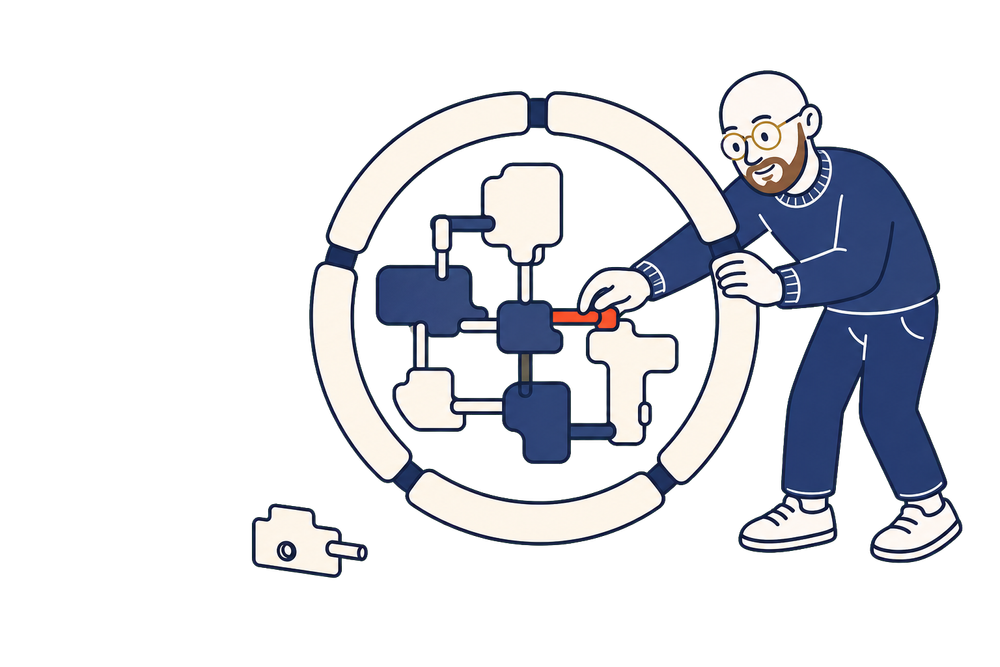
The Edge Loop is a five-step way to turn scattered AI use into proven improvements that fit your work.
Pick one real task. Test a better way. Measure the difference. Keep what works. Then stack the next gain.
The method is shared. The edge is yours.
Run your first loopA framework you can use. A system only you can build.
A copied prompt was written for someone else’s task, context and quality bar. That is why it can look clever and still do very little for you.
The Edge Loop starts somewhere different: with your work.
You test AI on the tasks you actually do. You judge it against what good means to you. You keep the parts that make you better and bin the parts that do not.
Over time, you stop borrowing isolated tricks and start building a way of working that reflects your judgement, your strengths and the results you need.
The five steps stay the same. What you build with them will not.
Copy this into a note before your next real task.
Do not redesign the way you work overnight.
Pick one task. Prove one gain. Make it yours. Then run the loop again.
Start your first loopFive steps. One loop. A system that keeps paying back.
Pick the task, not the tool.
Start with one real piece of work.
Not a theoretical use case. Not a polished demo. Something you already do and will need to do again.
Keep it narrow. “Use AI for project management” is too broad. “Turn my weekly project notes into a clear stakeholder update” is testable.
Write your experiment in one sentence:
When I [do this task], I want to test whether AI can help me [make this improvement] without [lowering this quality standard].
The best first experiment is not the most impressive one. It is the one you can run on real work this week.
You leave with
one task, one desired gain and one quality bar.
Test one better way.
Run AI against the way you do the task today.
Use the same work, the same starting material and the same expected result. Change one main thing: the role AI plays in getting you there.
This is where your system starts becoming specific to you. The value is not in finding a magic prompt. It is in discovering what combination of context, instructions and human judgement produces better work for you.
Define the test before you run it:
Keep the comparison fair. A perfect AI demonstration tells you very little. A real task tells you whether the approach deserves a place in your work.
You leave with
a fair comparison between your current way and one possible better way.
Measure the whole job.
AI can make the first draft faster and the finished result slower.
Measure everything: setup, prompting, checking, correcting and completing the work. The gain only counts if the whole task gets better.
Then choose one guardrail: the standard you refuse to trade away.
If speed is the goal, accuracy might be the guardrail. If output is the goal, usefulness might be the guardrail.
Avoid vague verdicts such as “that felt quicker”. Record the before and after.
If you cannot describe the improvement with numbers or clear evidence, it is not proven yet.
You leave with
a result you can explain and trust.
Keep the win. Bin the noise.
A clever result once is not a new way of working.
Run the approach again on real examples. A useful rule is to prove it across three pieces of work before you make it part of your system.
If you keep it, capture the small amount someone would need to repeat it:
You are not saving a prompt. You are capturing a working method: AI plus your context, standards and judgement.
You leave with
an approach that has earned a place in the way you work.
Stack gains, not tools.
An isolated shortcut saves time once. A proven improvement built into your workflow keeps paying back.
Make the approach easy to repeat. Put it where the work already happens: in your template, checklist, saved instructions or process.
Then look for the next constraint.
Perhaps AI now produces the first draft quickly, but gathering the inputs still takes too long. That becomes the next task you pick. Run the loop again.
Each proven gain removes one piece of friction and reveals the next. Over time, those gains connect into a system built around how you think and work.
You are not adopting someone else’s setup. You are elevating your own.
Do not stack tools. Stack proven gains.
You leave with
a way of working that becomes more valuable every time you improve it.
From a weekly drag to a repeatable edge.
A weekly stakeholder update takes 60 minutes to pull together from project notes.
Use AI to create the first draft from the notes, a previous strong update and clear instructions about the audience.
Track total time, the number of factual corrections and whether the finished update meets the same quality bar.
Across three weeks, the task falls from 60 minutes to 25 with no increase in errors. Save the inputs, instructions and checking steps as a repeatable method.
Standardise how the project notes are captured so the draft can be created with less preparation. That becomes the next loop.
Someone else could use the same five steps. They would not build the same system, because they do not have the same work, audience, standards or judgement.
That is the point.
See the method being tested.
Every issue of The Experiment Log takes one real AI experiment from setup to verdict. You see what changed, what the numbers said and whether the approach was kept or binned.
One real experiment every fortnight. Keep only what works for you.
One real experiment every fortnight. Keep only what works for you.